Radon in Edmonton homes: should you test, and how?
Radon is one of those things you cannot see, smell or taste, and you cannot judge it by looking at a house. A brand-new home and a 1950s bungalow on the same street can test very differently. The only way to know is to measure it.
The good news is that testing is simple and high levels can be brought down. The tricky part for buyers is timing, because a proper test takes months and a purchase condition usually takes days.
What is radon, and why does it matter?
Radon is a radioactive gas that forms naturally when uranium in soil and rock breaks down. Outdoors it thins out quickly, but it can build up inside a home. Health Canada says long-term exposure is the second leading cause of lung cancer after smoking, and that the risk is much higher for people who smoke.
Radon gets in wherever the house touches the ground: cracks in the slab or foundation walls, gaps around pipes, floor drains and sump pits. In winter, a warm house tends to pull soil gas in, which is one reason Edmonton’s long heating season matters.
What is the radon guideline in Canada?
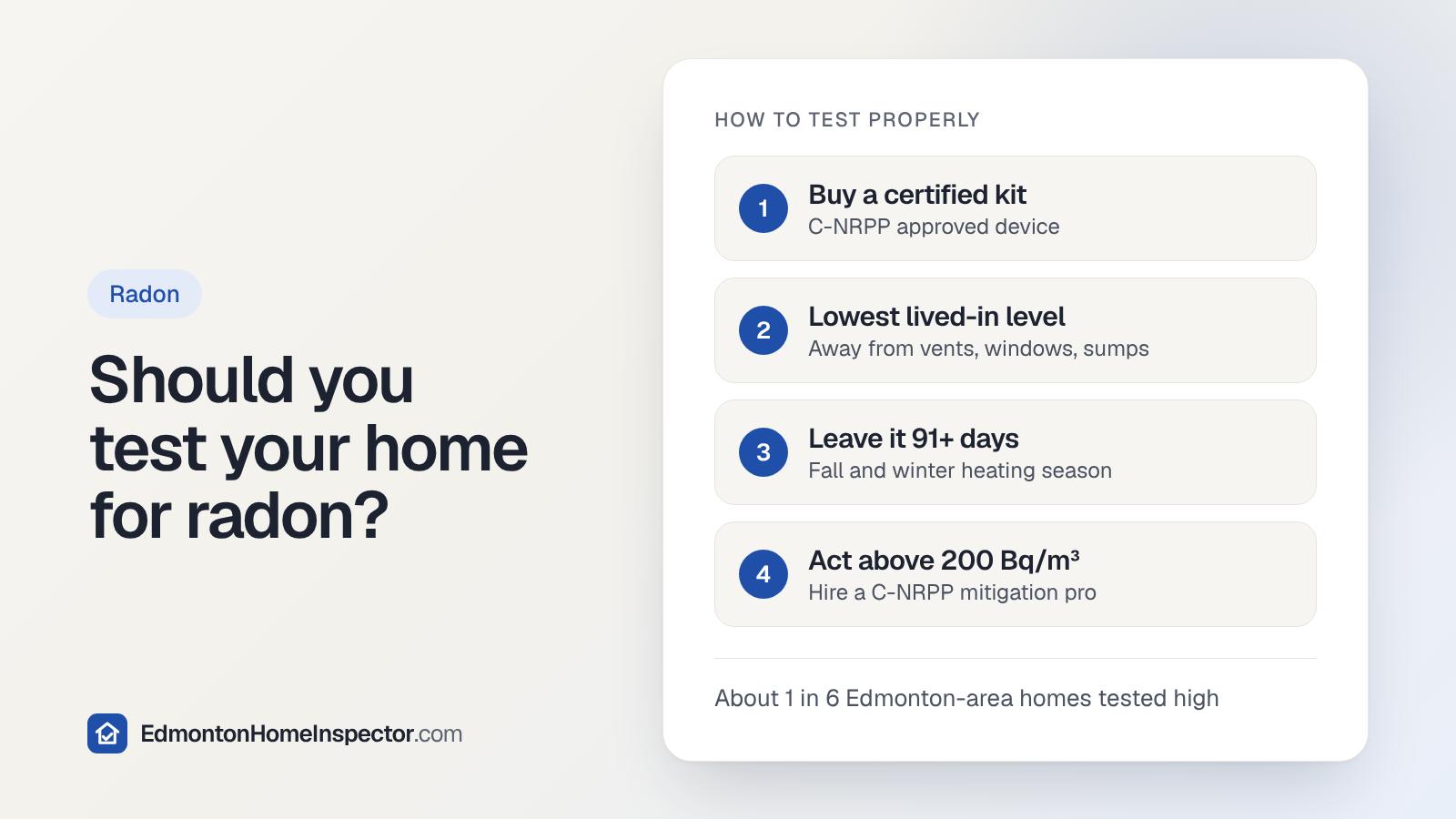
The Canadian guideline is 200 becquerels per cubic metre (Bq/m³). Health Canada’s radon guideline is the level above which it recommends you take action to reduce radon, and it is based on the average level over a year in the parts of the home people use.
Health Canada’s measurement guide sets out how quickly to act. In its tiered timeframes, results above 600 Bq/m³ should be reduced within a year, and results between 200 and 600 Bq/m³ within two years. Its newer guidance also encourages acting within a year for any result above 200, and sooner when the level is higher.
How common is high radon in Edmonton?
More common than many people expect. The 2024 Cross-Canada Survey of Radon Exposure, led by the University of Calgary’s Evict Radon team, reported that about 1 in 6 homes in the Edmonton metro area were above 200 Bq/m³, with an average reading of about 106 Bq/m³.
That means most Edmonton homes are below the guideline, but a meaningful share are not, and there is no reliable way to tell which group a house is in without testing. Neighbourhood, age and style of home are not enough to go on.
Should I use a long-term or short-term radon test?
Use a long-term test. Health Canada’s guide to testing your home recommends a test of at least three months, and its measurement guide treats 91 days as the minimum for a reliable estimate of your yearly average.
Here is how the two types compare:
- Long-term test (91 days or more). A small passive detector or a certified digital monitor left in place through the heating season. This is the result Health Canada uses to decide whether you need to act.
- Short-term test (a few days). Useful as a first look, but radon levels swing from day to day. Health Canada says short tests can give false positive or negative results and are not appropriate for deciding whether a home needs mitigation.
Timing matters too. Health Canada’s seasonal survey found that summer tests underestimated yearly radon levels in all regions of Canada, so aim for fall and winter, when windows are closed and the furnace is running.
How do I test my home for radon properly?
It takes a few minutes to set up and then you mostly leave it alone.
- Buy a certified device. Health Canada advises using a test kit or monitor approved through the Canadian National Radon Proficiency Program (C-NRPP), or hiring a C-NRPP certified measurement professional.
- Place it in the lowest lived-in level. Per Health Canada’s testing guidance, that is usually a finished basement, or the main floor if the basement is not used. Its measurement guide says to place the detector in the breathing zone, at least 30 cm above the floor, about a metre from vents, windows and doors, and away from sump holes and foundation cracks.
- Leave it for at least three months during the heating season, and live normally.
- Send it to the lab (for a passive detector) or record the long-term average (for a digital monitor), and keep the dated result for your records.
Can I test for radon during a home purchase in Alberta?
Not properly within a normal condition period. A three-month test does not fit into the few days most buyers have before conditions come off, and Health Canada recognises this.
Health Canada’s page on radon in real estate does not recommend relying on a test done during the transaction. Instead it suggests a holdback clause: part of the sale funds are held back so a long-term test can be done after possession, with money available for mitigation if the result is high. It notes that the Real Estate Council of Alberta has pointed to holdbacks as a possible solution. Ask your realtor and lawyer whether a holdback makes sense for your deal.
Other practical options for buyers:
- Ask the seller for past results. A long-term test with dates, device type and location is far more useful than a verbal "we tested once".
- Plan to test after you move in. Put a long-term test on your first-fall to-do list, whatever the seller says.
- Look for an existing system. A pipe coming up from the basement slab with a small fan and a pressure gauge is often a sign of a mitigation system. Ask when it was installed and whether it was retested afterward.
Radon is outside a standard visual home inspection, so it is not something an inspector can confirm on the day. Read what a home inspection includes for the full scope, and our checklist for what to ask the seller.
What happens if my radon test is high?
You fix it, and it is usually a manageable project. Health Canada’s radon reduction factsheet says the most common method is active soil depressurization: a pipe runs from below the basement slab to the outside, and a small fan draws radon out before it can enter the home. It says these systems can cut radon by 90% or more and usually take less than a day to install.
A few points to keep in mind:
- Use a C-NRPP certified mitigation professional. You can search for one through C-NRPP. Health Canada recommends certified professionals for both testing and mitigation.
- Retest afterward. A follow-up long-term test confirms the system is working.
- Cost. Health Canada describes the cost as similar to other common home improvements. For an actual number, get quotes from certified mitigation contractors.
Do new homes in Edmonton have radon?
They can. A new house is not automatically low in radon, so it needs a long-term test like any other. Health Canada’s reduction factsheet recommends passive soil depressurization in new homes: a pipe from under the slab that can later be fitted with a fan. If you are buying new, ask the builder whether the home has one. Our guide to new home inspections and Alberta warranty covers other questions to ask a builder.
Whether you are buying in Edmonton, St. Albert or Sherwood Park, the advice is the same: test every home you live in, in the heating season, with a certified long-term device.
Sources
- Radon guideline, Health Canada
- Guide for radon measurements in residential dwellings (homes), Health Canada
- Testing your home for radon, Health Canada
- Radon in real estate, Health Canada
- Reduce radon in your home (factsheet), Health Canada
- Radon: Another reason to quit (factsheet), Health Canada
- Seasonal variation of radon in Canadian homes: Early survey results, Health Canada
- Radon Research Series: Radon Levels in Canada’s Six Largest Cities, Evict Radon National Study (University of Calgary)
- Canadian National Radon Proficiency Program, C-NRPP
Founder
Banish is the founder of EdmontonHomeInspector.com, a home inspection business starting up in the Edmonton area. These guides explain Alberta's rules and common house issues in plain language, and every fact links to its official source at the end of the post. Licence numbers will be listed here once issued.
Last reviewed