What happens during a home inspection, and should you be there?
Your offer has been accepted, the inspection is booked, and now you are wondering what actually happens on the day. The short version: the inspector spends a few hours looking carefully at the home, and you get the most out of it by being there and asking questions.
This post walks through the day from start to finish, so nothing about it feels unfamiliar. If you want the full list of what an inspection covers, see what a home inspection includes in Alberta.
Should you be at the home inspection?
Yes, if you can. The Government of Alberta's guide to hiring a home inspector says the inspector should walk through the home with you and point out any problems. Seeing a soft spot in a floor or a stain under a sink in person is far clearer than reading about it later.
You do not have to follow the inspector for every minute. Many buyers arrive near the start, step back while the inspector works, and then join a walkthrough at the end. If you cannot attend, ask whether a call to go over the findings is possible, and have your REALTOR® there to provide access.
How long does a home inspection take?
For a typical detached house, plan for a few hours. A condo apartment is usually shorter, because the roof, foundation and most shared systems belong to the corporation rather than to you.
Things that add time:
- A larger home, or one with a finished basement, a basement suite or a detached garage you have asked to include.
- An older home with more original systems to look at closely.
- Several heating or water heating systems, such as a furnace plus a boiler for in-floor heat.
- Winter conditions, cramped attics or a lot of stored belongings in the way.
Allow extra time at the end for the walkthrough and your questions. Rushing that part is the most common way buyers leave with less than they paid for.
What does the inspector do, room by room?
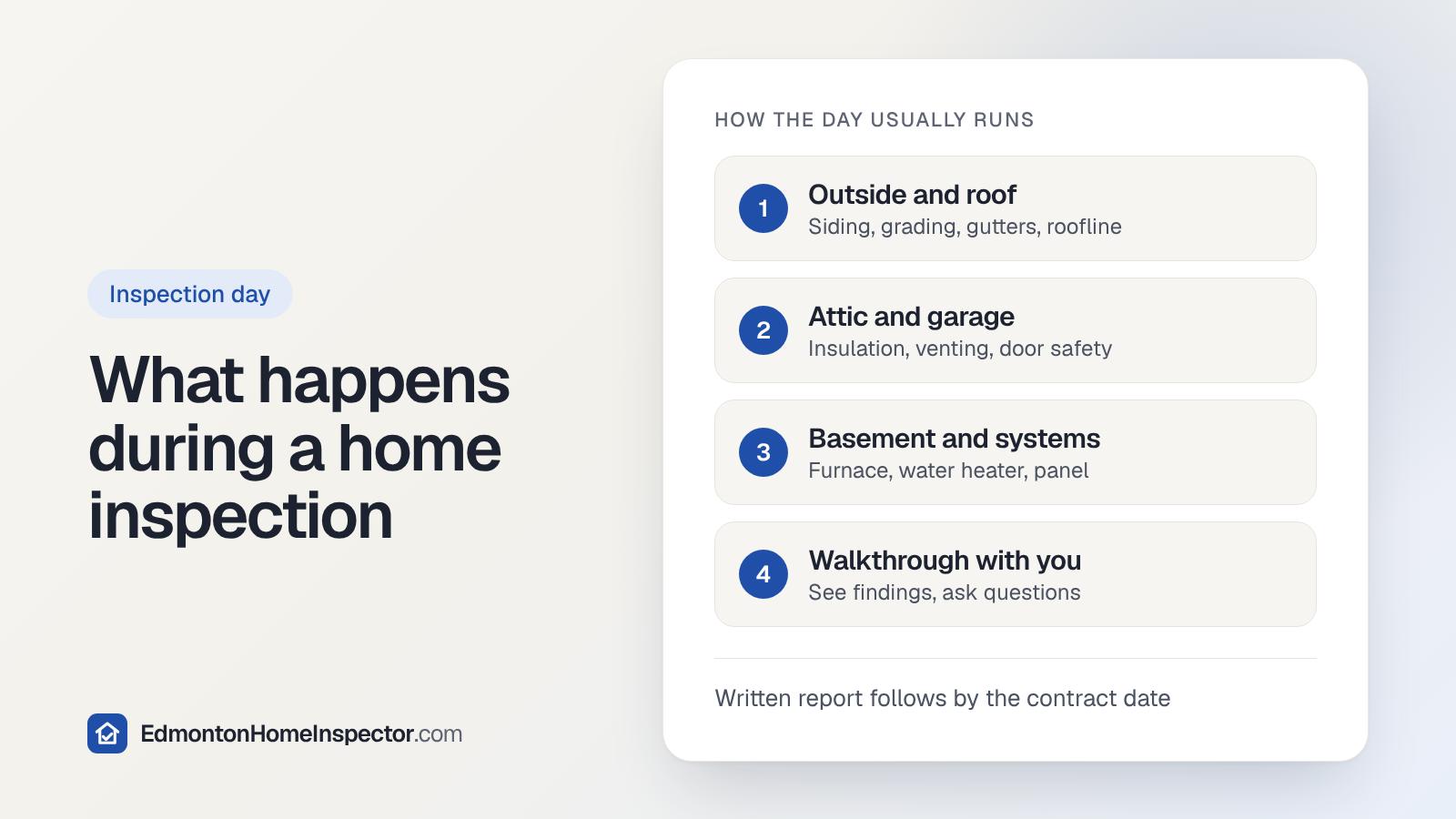
Alberta's Home Inspection Business Regulation describes an inspection as based primarily on a non-invasive look at the readily accessible parts of the home. In practice the inspector looks, runs normal controls and uses ordinary tools. A common order looks like this:
- Outside first. Siding, windows, doors, decks, grading, gutters and downspouts. The roof is looked at from where it can be safely seen or reached.
- Garage. The door and its safety reverse, the wall and door shared with the house, and visible wiring.
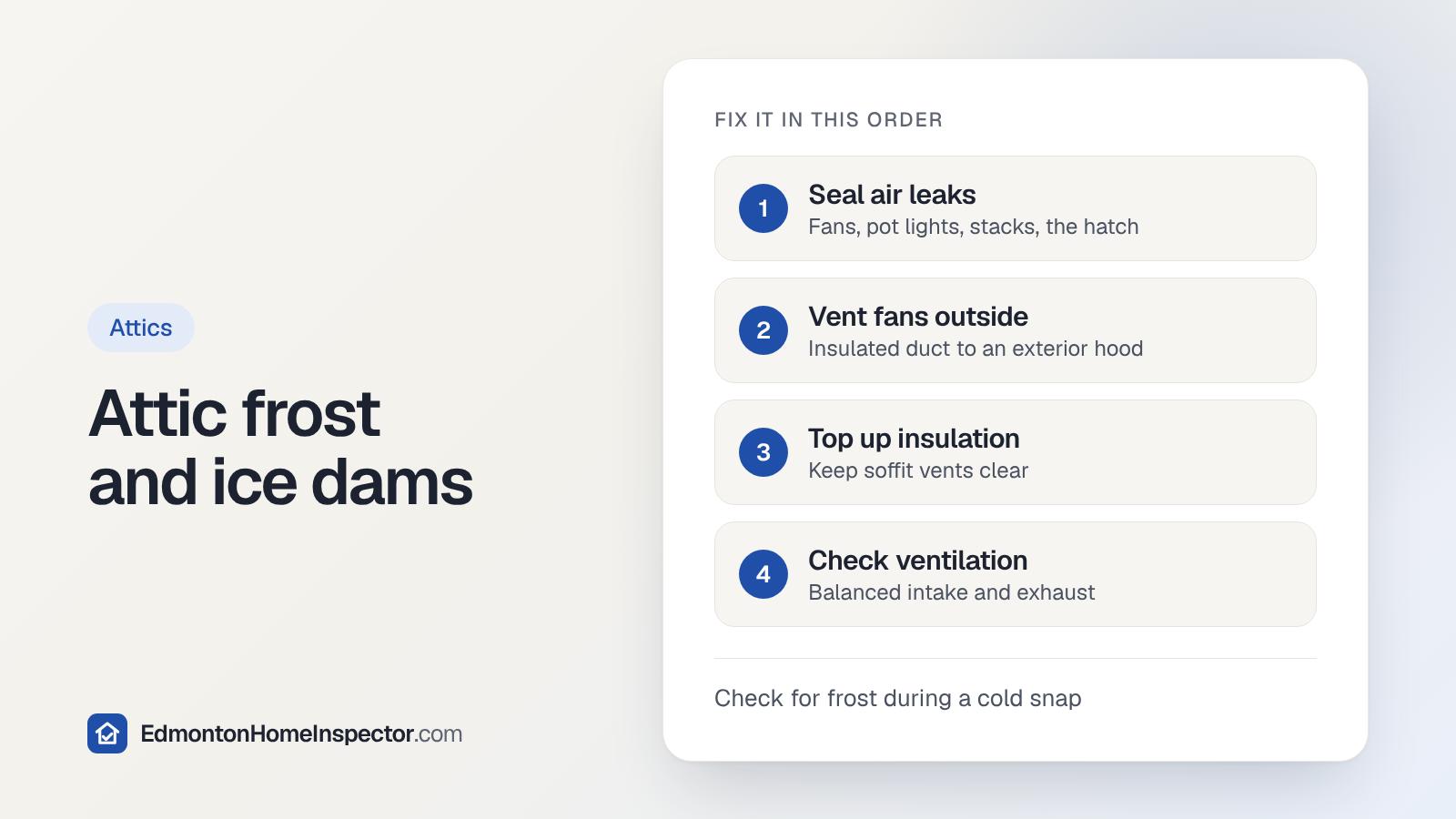
- Attic. Insulation, ventilation, signs of frost or past leaks, and bathroom fans that should vent outside, not into the attic.
- Basement and mechanical room. The visible foundation, framing, furnace or boiler and its venting, water heater, electrical panel, main water shut-off and drains.
- Kitchen and bathrooms. Fixtures run, drains tested, GFCI outlets checked near water, and built-in appliances run through a basic cycle.
- Living spaces and bedrooms. Walls, ceilings, floors, stairs, railings, windows and a sample of outlets and switches.
In a condo, the same approach is applied to the unit and its systems, plus the shared areas the inspector can see.
The inspector will not cut into walls, lift flooring, move heavy furniture or take equipment apart. Where something is hidden, the report describes the signs around it.
What should you bring to the inspection?
Not much. These help:
- The list of questions or concerns you noted at the showing.
- A phone for your own photos and notes, and a tape measure if you are planning furniture or renovations.
- Any seller disclosure, permit history or renovation details your REALTOR® has shared.
- Comfortable shoes and, in winter, a warm layer for the garage and outside.
- A printed or saved copy of our home inspection checklist.
It is best to leave young children and pets with someone else if you can. Attics, open electrical panels and unfinished basements are not great places for them, and you will want to focus.
What questions should you ask on the day?
Good questions are about understanding a finding, not about whether to buy. Try these:
- Is this a safety issue, a sign of something bigger, or routine maintenance?
- What would you want a specialist to look at, and which kind of specialist?
- Is this something to deal with before winter, or something to plan for?
- Where are the main water shut-off, the gas shut-off and the electrical panel?
- Was anything not inspected today, and why?
One question the inspector cannot answer is what a repair will cost. Under Alberta's Home Inspection Business Regulation, neither an inspector nor an inspection business may give you an estimate of the cost of a repair or improvement. That is a job for contractors, and it is covered in what to do after a home inspection.
Who else is usually there?
Usually your REALTOR®, who arranges access with the listing side. Sellers are often asked to be out during a buyer inspection, which makes it easier for you to ask candid questions. If the home is tenanted, the tenant may be home, so be respectful of their space and belongings.
Before you leave, make sure everything is returned to how you found it: lights off, thermostat reset, doors locked and taps closed.
What happens after the inspection?
The written report comes next. The regulation requires the report to be in writing, to address each part of the home included in the contract, and to reach you on or before the date set in the contract. It also cannot be shared without your written permission, except where the law requires it or there is a serious health or safety risk.
Then the clock matters. Your inspection condition has a deadline, so in the next day or two:
- Read the whole report, not only the summary. Our guide on how to read a home inspection report explains what is serious and what is not.
- Book any specialist the report recommends, such as an electrician, plumber or roofer.
- Talk to your REALTOR® about your options, from going ahead as is to asking for a change.
- Check how your condition of sale is worded and when it ends.
You can see how findings are laid out on the sample report page. When you are ready, join the priority list for an inspection in Edmonton or Sherwood Park.
Sources
- Hiring a home inspector, Government of Alberta
- Home Inspection Business Regulation (Alta Reg 75/2011), Alberta King's Printer
Founder
Banish is the founder of EdmontonHomeInspector.com, a home inspection business starting up in the Edmonton area. These guides explain Alberta's rules and common house issues in plain language, and every fact links to its official source at the end of the post. Licence numbers will be listed here once issued.
Last reviewed