How to read a home inspection report: what's serious and what isn't
A home inspection report can be long, and the first read can feel alarming. Forty or fifty findings on a perfectly good house is normal. Most are small, and the report is doing its job by writing them down.
The skill is sorting. Once you know which findings are about safety, which are expensive problems, and which are simple upkeep, the report becomes a to-do list rather than a list of worries.
What does Alberta require a home inspection report to include?
Alberta's Home Inspection Business Regulation sets the basics. The report must be in writing and legible, address every part of the home included in the contract, and make recommendations on any deficiencies found. A recommendation to get an expert opinion counts as a recommendation.
The same regulation does not allow inspectors or inspection businesses to estimate the cost of a repair or improvement. So the report tells you what is wrong and what to do next, but not what it will cost. For the full list of what the contract and report must contain, see what a home inspection includes.
How are findings usually grouped?
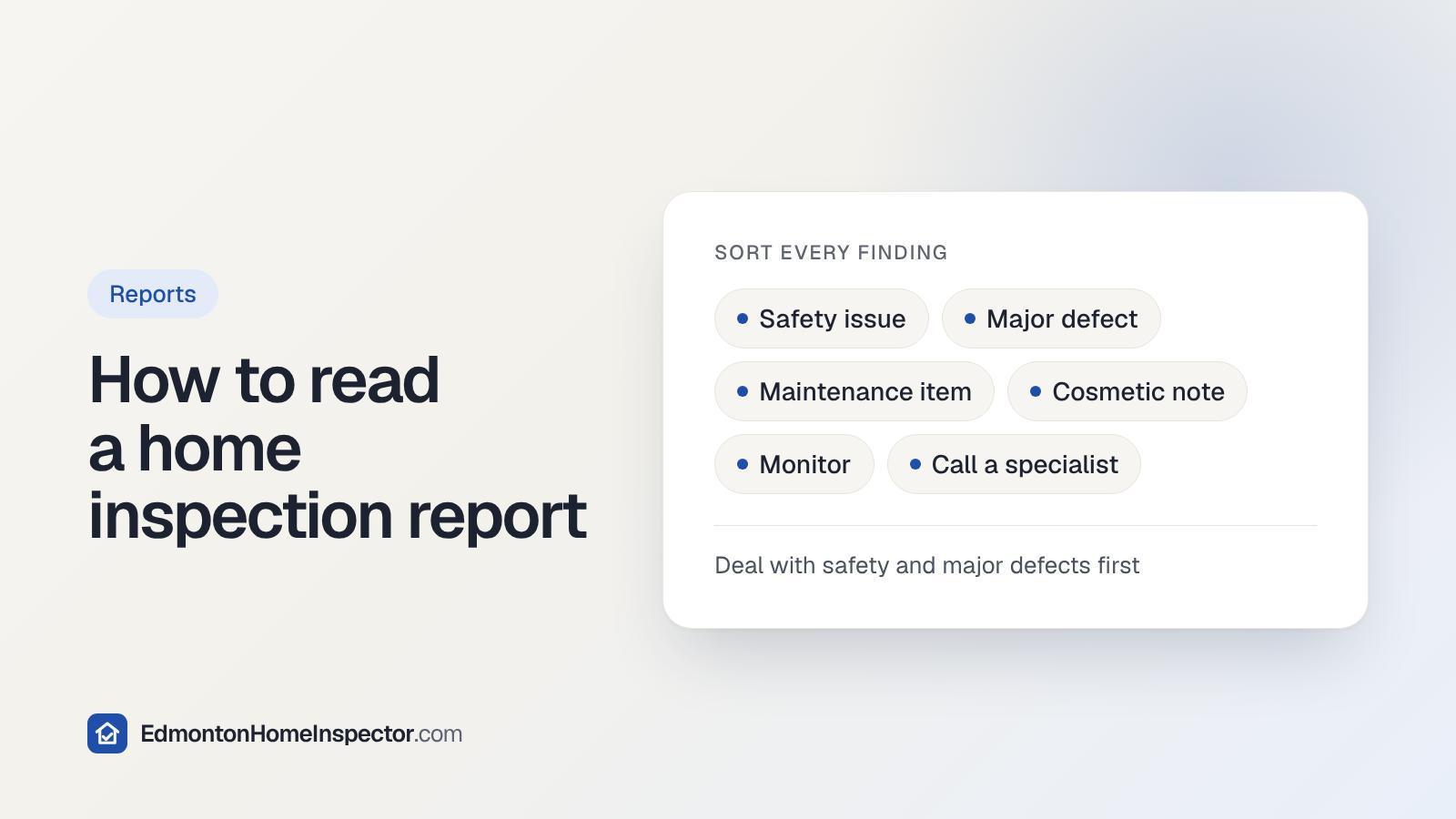
Most reports sort findings by how urgent they are, though each inspector uses their own labels. A useful way to read any report is to place each finding in one of four groups:
- Safety issues: something that could hurt someone now.
- Major defects: a significant problem with a system or the structure, or something that could cause bigger damage if left.
- Maintenance items: normal upkeep every home needs.
- Cosmetic notes: appearance only.
If your report uses different words, such as "repair", "improve" or "for your information", check its key or introduction. The sample report shows how ours is laid out.
What counts as a safety issue?
A safety issue is anything that could cause injury, fire, shock or poisoning. These go to the top of the list whatever they cost, because they need attention before you move in. Common examples:
- Furnace, boiler or water heater venting that is disconnected, corroded or poorly sloped.
- Missing or old smoke and carbon monoxide alarms.
- Exposed wiring, open junction boxes, or outlets near water without GFCI protection.
- Missing handrails or guards on stairs and decks.
- A garage door that does not reverse when it meets an obstruction.
On venting and alarms, Health Canada advises having fuel-burning appliances inspected by a professional at least once a year, watching for corroded or disconnected vents, and installing carbon monoxide alarms in your home.
What is a major defect?
A major defect is a significant problem with how the home is built or how a system works. It often needs a specialist and can affect your decision or your price. Examples:
- Signs of active water getting into the basement, roof or walls.
- Foundation cracks with displacement, or framing that has moved. See wet basements and foundation cracks.
- A roof covering that appears worn out or is leaking.
- Heating, plumbing or electrical systems that are not working as intended, or materials insurers ask about, such as Poly-B pipe.
A major defect is not automatically a reason to walk away. It is a reason to get more information, fast.
What are maintenance items and cosmetic notes?
Maintenance items are the small jobs that keep a home healthy: caulking around a tub, cleaning gutters, extending a downspout, changing a furnace filter, or adjusting a sticking door. They matter because small water problems become big ones if ignored, but they rarely change a buying decision.
Some findings note that a system is near the end of its typical life. That is planning information, not a defect. Our guide to home system lifespans in Edmonton can help you budget.
Cosmetic notes cover scuffs, worn carpet, nail pops and dated finishes. Many reports skip these entirely, because you could see them at the showing.
What does "monitor" mean in an inspection report?
It means the inspector saw something that is not a clear problem today but could become one. Watch it over time and act if it changes.
Typical "monitor" items include a hairline crack in a basement floor, a minor stain with no sign of current moisture, or a sealant joint starting to dry out. A simple way to monitor is to take a dated photo, mark the ends of a crack with a pencil, and look again each season. If it grows, gets wet or changes, call the right specialist.
Why does the report say to call a specialist?
Because a home inspection is a general, visual look across the whole home. When the inspector sees signs of a problem that needs closer testing or opening up, the right move is to send you to someone who does that work every day.
Common referrals and who they go to:
- Electrical concerns: a licensed electrician.
- Leaks, old supply pipe or slow drains: a licensed plumber, and a sewer scope for the main drain.
- Furnace, boiler or venting: a gas fitter or HVAC technician.
- Roof wear or leaks: a roofer.
- Cracks or movement: a structural engineer or foundation specialist.
Some things are outside a standard inspection altogether. Radon is one: Health Canada recommends a long-term test of at least 91 days, mostly during the heating season. See radon testing in Edmonton.
How do you prioritise before your condition deadline?
Work through the report in this order, and do it in the first day or two:
- List every safety issue and major defect on one page. Leave the rest for later.
- Book specialists for anything the report says needs a closer look. Their availability is often the tightest part of the timeline.
- Call your insurance broker about anything that might affect coverage. The Financial Consumer Agency of Canada notes that insurers consider a home's characteristics, such as its age and materials.
- Get quotes from contractors for the items that matter most, since the inspector cannot give cost estimates.
- Meet with your REALTOR® to decide whether to go ahead, ask for a change or walk away.
Our guide on what to do after a home inspection covers that last step. A pre-purchase inspection report is built to make this sorting quicker, with each finding saying what it is, why it matters and what to do next.
Sources
- Home Inspection Business Regulation (Alta Reg 75/2011), Alberta King's Printer
- Carbon monoxide: Preventing exposure, Health Canada
- Guide for radon measurements in residential dwellings (homes), Health Canada
- Home insurance, Financial Consumer Agency of Canada
Founder
Banish is the founder of EdmontonHomeInspector.com, a home inspection business starting up in the Edmonton area. These guides explain Alberta's rules and common house issues in plain language, and every fact links to its official source at the end of the post. Licence numbers will be listed here once issued.
Last reviewed